
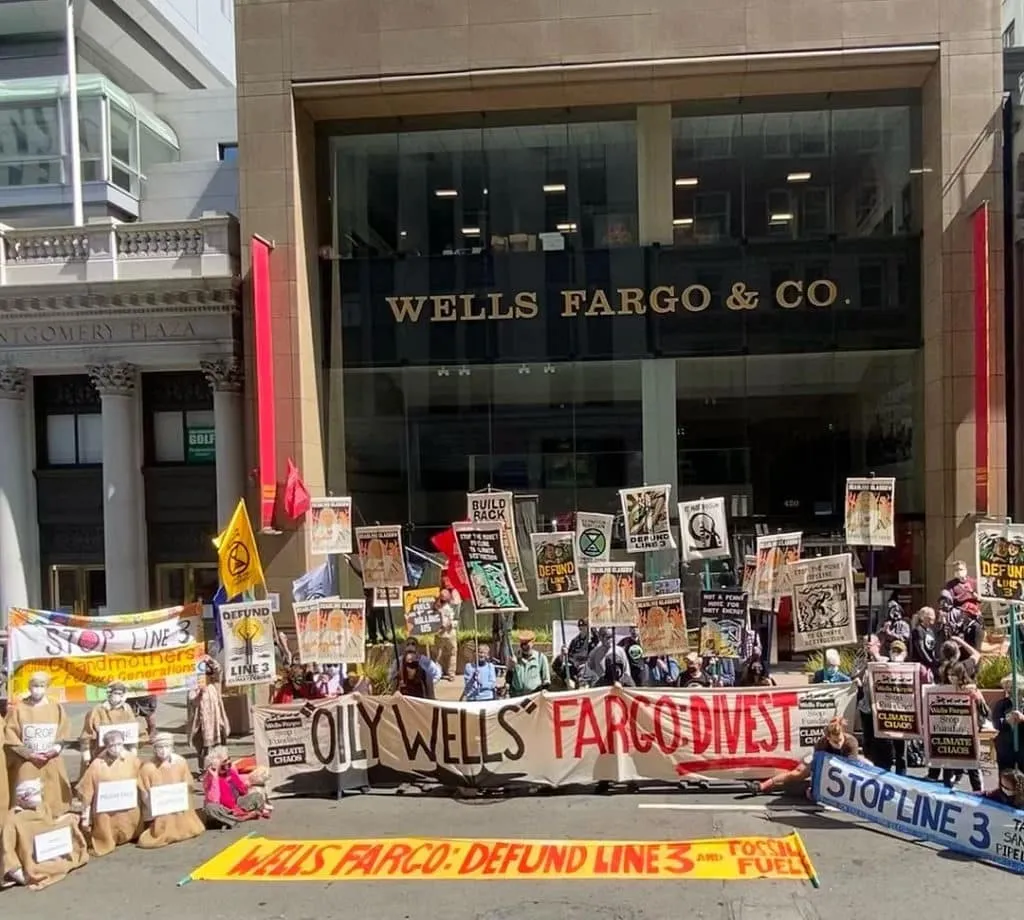
As a climate activist and rank and file labor militant, I have often thought of how these two movements can merge and become one strong movement for a livable, thriving planet and a society run and controlled by the working class. Far too often these movements are pitted against each other with the interests of workers coming in conflict with the right for breathable air, clean water, and a stable climate. More often than not, workers do not think to leverage our power to fight for a sustainable environment. For these reasons, I was excited to learn about how the Wells Fargo unionization campaign and the work of Stop the Money Pipeline has come together to fight for both unionization of Wells Fargo workers and divestment from fossil fuels. Below is my interview with organizers Cole Weber and Sarah Lasoff to learn more about this important work.
Editor's Note: The following transcript of the interview has been lightly edited to remove some conversational banter, niceties, or terminated sentences, in order to preserve the content of the interview in a clearer form. The unedited audio of the interview is available in this linked audio file.
Jessica
Can you tell me a bit about the Wells Fargo Union Drive campaign? Where it originated, all that.
Cole
It originated out of an organization called the Committee for Better Banks, which started back in 2016. It was mostly a way for multiple different organizations to push back against a lot of the worst, most egregious problems that banking was having, because this was also around the time of the Wells Fargo fake account scandal and things like that. But since that time, around 2022, we really started doing a lot of, specifically, union organizing through the CWA, the Communication Workers of America. We started our very first unionized branch in Albuquerque, New Mexico, to unionize Wells Fargo in 2022. We currently have 28 branches and one office team, which is the Conduct Management Team, that are formally organized and have held their elections with the National Labor Relations Board. We're currently negotiating for a contract with Wells Fargo. They've been engaged in some pretty significant union-busting activities, but we're fighting back and trying to hold their feet to the fire to win our very first contract that we consider to be fair and wins workers what they deserve. So that's what we're working on currently.
Jessica
My next question to Sarah, can you tell me a little history, a little of the background and history of the Stop the Money Pipeline organization organization.
Sarah
Stop the Money Pipeline launched in early 2020 after a group of 40 plus leading climate organizers gathered for a week to figure out how we are going to move the financial sector away from fossil fuels and more towards more sustainable energy financing. The key here is that these organizations realize that if we're going to move the fossil fuel industry, if we're going to transition, we need to cut off their source of money, and that these large financial institutions, particularly US financial institutions, like Chase, Wells Fargo, Bank of America, Citi Bank, and many more, that these are the biggest players in the world when it comes to banks financing fossil fuels. And so they decided that we need to hold US financial systems accountable, including banks, but also not limited to asset managers, insurance companies, and these financial actors that prop up the fossil fuel industry If we're going to transition, we need to be moving money away from fossil fuels to sustainable energy. And since then, we've become the largest coalition in North America that's dedicated specifically to ending the financial support of the fossil fuel industry and funneling that money towards more sustainable efforts. We have over 230 coalition partners now and over 100,000 supporters. Our steering committee consists of leaders, environmental justice leaders and coalition leaders that represent our coalition.
Jessica
Cole, what are the current concerns that are really behind the union drive for most rank and file workers right now?
Cole
Most rank and file workers, our biggest concerns are primarily Wells Fargo, once again, putting sales pressure on branch workers, much like what led to the fake account scandal previously. Plus, there's been a lot of layoffs, both in the offices and in the branches, which has led to under staffing in both places. There's been a constant gaslighting of workers about ever-changing policies and procedures that they're not given sufficient training for every time the policies and procedures change, and then they just change again underneath them. And workers are being held to these impossible standards just because things are constantly changing under them and they're not given the resources and the training that they need to be able to actually do their job properly with those constantly shifting rules.
Jessica
How did the Wells Fargo Union drive and Stop the Money Pipeline join forces?
Sarah
I realize I don't have as many specific details, but I do know. What I do know is that basically Stop the Money Pipeline and the CWA, with mainly the Wells Fargo Workers United contingent of the CWA, saw an opportunity to join forces for better working conditions and climate issues. And this is because we are stronger together. If we can both work together with the power that we're building with the union and workers, and climate activists, and the general public, we can have more power to actually push Wells Fargo on both workers rights and climate issues. We realized or surfaced this understanding that workers are not isolated from their environment. And so if we're interested in fighting for workers, we need to think about the climate. I was just watching an interview of Greta Thunberg, and she's saying, I am fighting for climate justice because I care about human beings. And if we care about human beings, we need to think about climate issues. And so, Cole, I looked at your data that you gave me around the Wells Fargo branches that are likely to be affected by sea level rise. I did some quick math, and it seems like 21 % of all Wells Fargo branches in the US are likely to be affected by sea level rise. And also 56 % of the workforce is between 20 and 30. And we know that Gen Z and Millenial folks, over 60-70 % of them care about the climate. It's one of their top issues, because this is going to affect our generation much longer than older generations.
Jessica
So you talked a little bit about the role, why banks are a target for movement on climate issues. I'm wondering if you could explain, specifically, how is Wells Fargo on climate issues?
Cole
That's a great question, and that's really been a lot of discussion amongst our groups. Wells Fargo, previously, obviously, was a solid middle of the pack as far as banks go. Not great, not awful. However, what really changed things was in February of this year, Wells Fargo announced that they would be leaving the Net Zero Banking Alliance as well as dropping their 2030 and 2050 Financed Emissions Climate Goals, which is something that none of the other banks have done. So that was really our biggest concern. This was a public announcement that they made that they'd be dropping those goals. This has really upended a lot of what was previously some fairly good behavior on the part of Wells Fargo. They've completely stopped reporting any of their emissions standards. They've completely stopped reporting any of their output. It's suddenly become a black box inside Wells Fargo as far as how they're doing. And that's deeply concerning to all of us.
Sarah
Yeah. And I would push back a little bit, Cole, just on the like that they were middle of the pack before in terms of banks. I still think Wells Fargo Chase, Bank of America, Citi Bank, they're some of the worst actors in the world in terms of the financing of fossil fuels, just to clarify.
Cole
I guess I'll clarify that segment, middle of the pack as far as US banks. Sure. Not necessarily middle of the pack as far as banks worldwide. Worldwide, pretty bad. But US banks, in general, have always been the worst of the worst. And Wells Fargo was middle of the pack of the worst of the worst.
Sarah
Yeah. I would say, there's a lot of credit unions and banks that are much better than Wells Fargo, smaller banks. But Wells Fargo is amongst the top worst funders of fossil fuels in the world. They're in the top 10. And so, which makes it even more concerning that they completely dropped their climate targets, is they are one of the biggest actors in the world, funneling billions of dollars into the fossil fuel industry year after year. And to just say, oh, we don't care about our impact on the climate at all. Anymore is really, really concerning. And why we've decided to focus a lot of our attention on Wells Fargo and team up with the union to keep them accountable, but also send a message to the entire banking sector that this is not okay, and we absolutely can't have this backsliding.
Jessica
What have been some of the most positive aspects of this partnership that you've experienced or seen between the unionization effort of workers and Stop Money Pipeline?
Cole
It has been truly a great experience for me. I am very, very new to the organizing space. I started organizing as a worker at Wells Fargo for about a year, and then was let go due to a large layoff in my area and then started fully, formally working for the union once that layoff happened. But teaming up with Sarah and the rest of Stomp has shown me how labor and the environment are really enmeshed in a lot of our mutual concerns. It's really been valuable to me to see that from that intersectional perspective of how labor rights and environmental issues really are a lot of the same thing because it ultimately comes down to labor rights affect the middle class, the working class, and the poor way more than it affects the wealthy, much in the same way that environmental concerns are mostly going to impact the working class and the poor much more significantly than they the wealthy. There is a very large overlap of the people who will be most impacted by both of our concerns.
Sarah
I would say it's been extremely positive and thrilling and energizing this work. And it's been so wonderful to work with Cole. We both live in Portland, Oregon, so it's really wonderful to have in-person organizing that we get to do together on the streets, going out, canvassing workers, talking to each other about our issues and what's going on, our obstacles with our organizing. And so that's been a huge, wonderful part of the partnership, personally. But then I think overall, the movement has really benefited because we have this amazing sharing of resources and research, and we can share organizing lessons, what's working, what's not working. And just really, the more people there are, the more power we have. We have more capacity to lend to each other's efforts, to amplify each other's efforts. And I think most of all, it's been really valuable for us to hear from workers directly about what's actually going on at Wells Fargo. People who work at Wells Fargo know what's going on more than anyone else. So for us, as a climate movement, to hear how the business operates and what's happening on the inside is super, super valuable for our campaigning to try to figure out how we actually move this behemoth, this huge company.
Jessica
How do you feel about this partnership? What impact do you think it's having on rank and file workers? Just in terms of maybe feeling support from the movement around unionization or even just changing of consciousness around these issues and highlighting it in seeing these connections between movements, whatever it may be. How do you feel it's impacting rank and file workers?
Cole
So, one of the biggest impacts on rank and file workers is that we've had a lot of volunteers from the climate community who have volunteered to go out and actually do canvassing on our behalf to really raise awareness about the union. And that has been a huge impact overall. People are really providing us assistance in increasing awareness because ultimately, Wells Fargo's biggest goal is to try and downplay the union and try and pretend like we don't exist as much as possible. There are people out there who don't even know about us and haven't even heard of us. Having that assistance really matters a lot. Then on our end, we're beginning the process of creating a specific team of workers who are interested in engaging with the environment issues. We're calling it the Green Team because Wells Fargo used to have an ERG, an employee resource group that they maintained that was called the Green Team, but they abandoned it after COVID forced them to allow people to work remotely in many offices. Our goal is to try and rebuild that, but instead of being something that's managed by Wells Fargo, instead, something that's managed by the workers and something where the workers can really address their concerns about the environment.
Cole
Because it is something that comes up pretty regularly in conversations with workers about how they have deep concerns about the environment and specifically, Wells Fargo's impact on that.
Sarah
I would just add to Cole's point about the impact of folks going and canvassing Wells Fargo workers. Wells Fargo is a terribly egregious union busting company. It's really bad. And I would love... I mean, Cole, if you want to share the details that you know and have experienced yourself, I would love to hear that. But it's intimidating workers. They're literally... It's really bad. Having this culture of people who are potential customers or already Wells Fargo customers going in and saying, Oh, are you all unionized? I would love to do my business at a place that is taking care of its workers. Have you heard about the union? Let me tell you about it. It really helps to create this culture where it's safe to talk about it, where they can feel the public and their neighbors know about it and support them, and also do what Cole was saying, which is, Yeah, educate them about it. Just let them know that it's even happening at all in the first place.
10 Jessica
That seemed like a really innovative tactic around union organizing, because usually, typically with union organizing, my understanding is either you have a hired organizer or staff that is trying to engage people or rank and file members of a workplace that are engaging their coworkers. And I'm sure you're doing all of those things. But the added piece of people who are not necessarily employees and that are essentially doing the onion organizing by just spreading that awareness. That has just been a really innovative tactic before.
Cole
Yeah, we're really trying to embrace a diversity of tactics because Wells Fargo is a big target. They've recently engage the services of the notorious law firm, Littler Mendelsohn, to serve as their labor relations leads, as they call them. But let's be honest, they're union busters. That's their whole job. That's their whole thing. Especially Stan Sheryl, who is our wonderful friend from them, who has gone to visit multiple branches, especially branches that they suspect are trying to unionize and has been engaging in a lot of what we would consider illegal anti-union activity. We've actually submitted multiple ULP complaints about that. Obviously, we can't 100% legally say that they are illegal activity because there hasn't been a decision made on that yet, but we have some pretty strong feelings about that. We really need to embrace that diversity of tactics to have any chance of success at this, especially because our Wells Fargo branches are everywhere all across the country. We also have multiple call centers in multiple sites across the country, which really can create a sense of siloization that keeps workers really separate, and it makes it really hard for people to make those connections that are necessary for unionization.
Cole
We've been embracing new methods of social media contact, like Discord, and trying to create conversations that way, sharing resources with our environmental allies to help us out with that. Lots and lots of new tactics. That just really allows us to create those connections that's so vital to unionization.
Jessica
What have been some of the main challenges with this union drive?
Cole
Well, definitely a lot of what I mentioned, the anti-union pushback the ULPs that are still in decision making. I myself, back when I was a worker, filed a ULP complaint as well, and we won that because my manager tried to tell me that it was illegal for it or it was against the rules for us to even have flyers or union stuff on the property because it was considered solicitation, which, of course, it absolutely is not. It is illegal for them to try and tell us that, and we won that claim. It's really just been a lot of, sometimes blatantly illegal, pushback by Wells Fargo and union busting, sometimes less than blatant, sometimes technically legal, but stepping in line. But really, a lot of it is banks in the US broadly have never been unionized before. So it's facing that lack of history and that very independent feeling of bank workers tend to be very independent. They're like, I've got a good job. I've been doing all this work. I need to keep fighting for myself. There's a culture of competition that's maintained within a lot of Wells Fargo branches, especially with the sales pressures and things like that to get bonuses.
Cole
So it's been a lot of overcoming just the culture of banking as a whole and the siloization that Wells Fargo intentionally cultivates. That's been the really biggest part of it.
Sarah
And I'll just add one anecdote to, again, Wells Fargo's egregious union busting, but also just acting in bad faith. They recently were in bargaining negotiations with Wells Fargo workers, and they had someone eavesdropping on their bargaining session, which is deeply illegal. Which is illegal. And the way that... I mean, it's a hilarious article to read. It's really pretty humiliating for Wells Fargo. They literally had someone on their laptop, and someone came off of mute on the laptop on the Wells Fargo side. And it turned out to be that person- Stan from Littler Mendelsohn? Yes.
Cole
Stan. Stan, yes.
Sarah
Stan from the union-busting law firm. So that was pretty egregious. And just another example of how Wells Fargo has made it really challenging to unionize, for workers to unionize, which is illegal, because it's intimidation, and bad bargaining. Because of this, because it's been so egregious, there were actually 15 US senators that sent Wells Fargo a letter recently, asking them to stop with their union busting, because it's been so egregious, as I said.
Jessica
Wow. Well, so from what I understand, you have multiple sites that are unionized. Correct. But are you fighting for your first contract right now?
Cole
Yes, correct. We've been in negotiations for our first contract for over a year now since that first branch of the Albuquerque, New Mexico branch unionized, and Wells Fargo is continuing to engage in. Obviously, we can't legally claim it to be in bad faith, but let's be honest, it is in bad faith. They're not taking us seriously. They're not actually treating it like a real contract negotiation. They're trying to give us just bare minimum and hope we go away and just accept that, and we're not giving up on that. It's a very David versus Goliath situation at the moment, and that's what we're still working on. We're still working on that contract.
Jessica
And in the contract, I know you touched on this already. I believe you did. But what are the concerns in terms of what workers are fighting for and the changes you want in terms of climate action with this first contract.
Cole
So obviously, unfortunately, we can't discuss the details of the contract we're negotiating because It's just one of those security things. But broadly, because this is just our very first contract, we are trying to get mostly focused on things like pay benefits and things like that. Unfortunately, the very first contract will probably not reflect anything directly climate-related just because we don't have the power yet to really enforce anything like that. Obviously, as we get more branches and more unionized groups, we will have more power and more capability to actually do that. A lot of the environmental issues are going to be outside of the direct contract negotiation and more like putting pressure on them in other ways until we get to such a point where we can actually enforce a stronger contract and win stronger contracts, where the goal is to include things like going back to our 2030 and 2050 emissions goals, rejoining the Net Zero Banking Alliance, and ideally, getting more towards a true Net Zero emissions overall. But that is obviously much more of a longer term process.
Sarah
Yeah. Before, Wells Fargo dropped its targets. Still, we have this demand in our coalition, which Which is we have been pushing banks specifically to stop financing the expansion of the fossil fuel industry. You can see there's a lot of great public data on this now. Our friends at Rainforest Action Network have put together this report, Banking on Climate Chaos, that outlines how much these banks are funneling into the fossil fuel industry. They have a specific section on fossil fuel expansion, and you We can see the top players that are funneling money towards expanding the fossil fuel industry, which is exactly the opposite direction we need to go in order to stop a hole from getting bigger, you have to stop digging. We first need these financial institutions to commit to stop funding any expansion of the fossil fuel industry and exhilarate accelerate their financing of sustainable energy, because in order for us to hit these targets that Cole was mentioning, we have to rapidly accelerate the amount of money we're putting into sustainable finance Right now, our friends at Reclaim Finance, or they actually just released another report called Banking on Business as Usual that just came out two weeks ago.
Sarah
And it maps out the ratio of what banks are financing into sustainable finance versus fossil fuel finance. And that's because banks, in order to be on track to hit net zero by 2030, 2050, and to reach our intermediary goals at 2030, we need to have a 6 to one clean to dirty energy finance ratio. That means six dollars for every one dollar that we're putting into fossil fuel energy. We need to be putting six dollars into sustainable energy. But overall, global banks are at $0. 42 into sustainable energy for every $1 of fossil fuel energy.
Cole
And Wells Fargo is even lower than that.
Sarah
Yeah. Wells Fargo is at $0. 21 or something. It's like 21 cents. It's financially small. Yeah. 21 cents into sustainable finance for every dollar they're putting into fossil fuel.
But last thing on this is that Wells Fargo is... I have to check the exact ratio, but it has a ratio that is very far away from what it should be. And so we're also asking banks to increase their financing of sustainable energy. And because a lot of these banks will say, Oh, yeah, we have these, look how much money we're putting into sustainability. But when you actually look at it, compared to what they're putting into fossil fuel energy, it's substantially lower and it needs to be the opposite and some of how much money they're putting into. Fossil fuels needs to be put into sustainable energy.
Jessica
Are there any last comments in general about your thoughts around broadly the labor movement and climate movement working together. Anything you haven't said or anything you want to reiterate?
Cole
Just that I think it is so important for not just the climate movement and the labor movement, but all of the most important social justice movements currently to be working in a much more hand-in-hand way. Intersectionality really is key to getting what we need done in the world done, to have any chance of surviving the climate crisis that we're facing, as well as the democratic crisis we're facing, and so many other problems in the worlds that are currently there. We really need to exist as a much larger than just each of our own individual goals. Intersectionality is so key to the world that we live in right now.
Sarah
Yeah, absolutely. We are intersectional human beings. So if we want to be caring for human beings, we need to be thinking about all of the ways that we are impacted. And one of those issues includes the climate, but it also includes how you're treated in your workplace. So it's really exciting yet to be fighting for both of these issues together. And I'll say as a climate activist, just putting on my climate activist hat, even though I am also a worker. But as a climate activist, it really makes sense to be partnering with the union, because labor power is one of the most powerful levers that you can move when targeting a corporation, because we all know that corporations care about one thing: money. Absolutely. And so if you have an organized workforce, you have leverage over their revenue. You have leverage over their money, which can actually force Wells Fargo to come to the negotiating table on whatever issues that we deem that we want as workers, that we want to address.
Cole
The money that we, the workers, make for them.
Sarah
Exactly. So I think it's really important to consider that as well.
Jessica
Awesome. Well, my last question is, how can people support y’all's amazing work?
Cole
Yeah, we have a direct support petition that people can sign. I'm going to go ahead and pop that link in the chat if that's helpful. That way you can reference it later. But then also being part of this larger movement. We've got further trainings for more people to go out and hand out flyers at branches and spread the word about the union, which Sarah has the link for that as well. Our next training is going to October 30th. It is something we're going to be doing with some regularity as well. If people can't make it to this next training, there's going to be future trainings that they can be a part of. We are really looking at having the general public directly help us out with that process of advocating for environmental good through Wells Fargo and for increasing our unionization levels to help have that power to force them into doing what's right. Those are probably the two best things that people can do.
Sarah
I'll just add, if people who are reading this blog know someone that works for Wells Fargo, that is one of the best ways to get folks involved in the union effort, is that they should talk to them about the union, share the Wells Fargo Workers United website, and encourage their friend who works at Wells Fargo to sign up on the website and talk to a union organizer. And there's no commitment into doing that. If folks go on the website and sign up with their email, it just means that they can talk to someone within the union about the union and get more information for themselves about the effort. So I definitely encourage folks who know people who work at Wells Fargo to direct them to the website and to talk to them about the union. One other thing that we are going to be, we haven't started doing yet, but one of our goals for this next year is to establish support committees in all of the places where there are pre-existing unionized branches. So not only help grow the union by talking to new workers through canvassing, but we are also going to try to identify local leaders who can organize people in their community to support their local unionized branch.
Sarah
And so if folks are interested in that, then they should fill out this link. I have another link for that, that names all of the unionized branches. And so they can look and see like, oh, I live in San Diego, California. I would love to get involved in supporting my local union or unionized branch.
Jessica
It's Minneapolis in Saint Paul. Are there unionized branches there?
Sarah
I don't see Minneapolis.
Cole
Sorry, I'm not aware of a unionized branch there, but we do have a couple of our organizers who are actually local to that area. Specifically, Megan is in that area. We have a lot of really direct support there for people who are interested, and that's always excellent when we've got direct union organizers there who are present and can be helpful.
Jessica
Well, that would be really great if after this, if maybe via email, we could be... I'm in the Twin Cities, and I'm on the blog will be in the Twin Cities. So if it makes sense to have that direct connection in this piece. That would be wonderful. There we go. Perfect. Thank you, Sarah. I just wanted to put this in the chat. Those are all my questions, by the way. So thank you all so much for taking time. I'll put this in the chat because I know I started off the meeting a little sketchy not having my camera on. I don't know why it has that picture, but this is information about me and the climate and labor work I do. So I'm a real person. Amazing.
Sarah
Thank you.
Jessica
But, yeah, if there's any resources for just connecting with the local situation here, I did an ECO Justice Group within my union, my educator union. And I think it was awesome if our caucus to connect the labor and the ECO piece in solidarity with other unions could go and fly her at the local Wells Fargo or whatever.
Cole
We love local solidarity and local organizing to share with other unions. It's a really big part of our practice. And so we think that that's really important. So, yeah, I will absolutely, when I have the opportunity, I probably won't get to it today because I've got several other meetings today, but maybe tomorrow or Wednesday, I can send you. I'll probably copy you on an email to Megan so we can get you both in touch. I think that'd be really useful.
Jessica
Awesome. Well, I'm not going to hold you on any longer. You're busy people. So thank you so much for taking time. I hope it is a helpful piece.
Comments