
“My lungs strained, but not from the exertion of pushing the dumpster. It was light work with the four new companions I had made in the street, whose names I did not know and would not learn. It was the tear gas, clawing at my throat. I had already washed my eyes and mouth out two or three times, and my drenched scarf was now frozen to my icicle-laden beard, my cheeks numb but tingling with chemical irritants. We pushed through the smoke. We expected to catch up with the armored car and riot squad, which kept falling back. Instead, through the haze, we saw that we were pushing our load right into a pile-up of more of the same. A barricade, across the entire street. People had climbed up onto it. They were celebrating. That was when I realized the cops had stopped firing.”- A partisan of the battle of Whittier, oral account paraphrased.
Last Saturday, the 24th of January, we experienced our third shooting of a community member and second local uprising against the federal occupation of Minneapolis. This murder came on the heels of the first general strike in our city in 92 years. The beating and shooting of ICU nurse and union brother Alex Pretti by ICE highlighted the casual, murderous violence of the occupation. The victory of the people of Minneapolis in the ensuing clashes in Whittier, and the day-long temporary autonomous zone held along Eat Street, showed the country and the world that the regime is failing to control our metro. This has spurred a reformulation of counterinsurgency strategies at the local, state, and federal levels of government. This marks a turning point in the Battle of Minneapolis into yet-uncharted waters.
The morning of the 24th found the occupier on the back foot. The day before, tens of thousands of Twin Cities workers walked off the job, grinding business to a standstill in much of the metro, and marching through downtown Minneapolis with a crowd of some hundred thousand. The day was also filled with direct action. A mass protest shut down the MSP airport for hours as dozens of clergy were arrested in acts of civil disobedience. A blockade with shield walls, reinforced banners, and trailers tipped over onto roadways trapped ICE’s kidnapping gangs inside their lair at the Whipple building for much of the morning. Sunset brought no reprieve, as the noise demonstrations at hotels, now an almost nightly occurrence, gave no peace to the servants of a government that gives us no justice.
That was Friday. On Saturday, ICE hit the streets aggressively. Community defenders were there to meet them, as we have been every day. Whittier is a neighborhood tucked south of Downtown and north of Uptown, home to the immigrant-owned restaurants along Eat Street and the art school, MCAD. The neighborhood is no stranger to community self defense. During the first Trump administration, the Minneapolis Institute of Arts was the scene of that period’s first antifascist action in the Twin Cities, as the Industrial Workers of the World’s General Defense Committee confronted and defeated the white nationalists of Alt Right MN. During the Uprising in 2020 after the murder of George Floyd, the restaurant dumpsters along Eat Street turned into barricades for community patrol checkpoints. The Greenway at the south edge of the neighborhood became a natural barrier for protestors falling back after the massive deployment of tear gas around the Fifth Precinct when that precinct became the focal point of south side’s rage after the Third Precinct was sacked. Local restaurants like Pimento had served as hubs of mutual aid during the pandemic and Uprising. Throughout the months and years that followed, some of those who had defended the community during those early summer days organized into Whittier Cop Watch, one of the longest sustained and most active local community self defense formations to rise out of 2020. Throughout the occupation by ICE this winter, Whittier and especially Eat Street has been a target for the Feds, and a fortress for the people.
Just before 9 AM, the whistles started blowing on Eat Street. ICE agents were pursuing a man, who ran from them into Glam Doll Donuts, where the staff quickly locked the door and denied entry to the kidnappers. Unable to size their intended victim, regime forces turned to the growing crowd of legal observers and commuters gathering outside. The agents crossed the street to confront Pretti, pushing him back as he held his cell phone up and filmed them. Shortly after, the agents began targeting a woman who was observing, pinning her to the ground. Pretti yelled at the agents, telling them to leave her alone. The agents stormed over to Pretti and other observers, shoving a woman who was watching them. Alex placed himself between the woman and her attacker, who then sprayed him in the face with mace. Half a dozen ICE agents swarmed Alex, forcing him to the ground and throwing wild haymaker punches into him. One of the men assaulting him reached down and pulled Alex’s handgun, for which he had a permit, from his belt. One of the other agents then pulled his own gun and began shooting Alex. The initial gunshot caused the remaining agents to fumble their own weapons out, emptying round after round into Alex Pretti as he lay bleeding in the snow. Then they clapped.
It’s unclear what exactly sparked the shooting. Some video seems to show the officer who took his gun shouting “Gun! Gun!”, sparking the panicked response from another of Alex’s attackers. Other video shows his killers asking “Where’s the gun?” in the aftermath of his killing.
It is very clear, however, what the murder of Alex Pretti unleashed. In 1860, as the United States careened towards a Civil War that pitted white supremacy and chattel slavery against the professed ideas of liberty and equality which they had too long rubbed against, the Texan Sam Huston warned his fellow Confederates, “[The North] are not a fiery, impulsive people are you are, for they in colder climates. But when they begin to move in a given direction, they move with the steady momentum and perseverance of a mighty avalanche”. The shots that murdered Alex, had shaken loose the avalanche.
It is the natural instinct of humans to run from gunfire. We and our neighbors ran towards it. Within minutes, dozens became hundreds. By the end of the day, hundreds would become thousands. The agents began rifling through Alex’s belongings as he lay dying, neglecting his wounds and denying medical workers present the chance to attend to their fallen colleague. In the minutes that Alex died, bleeding from ten bullet wounds, this demand- the demand to be allowed to help him- became the first focal point of the people’s anger. After crucial minutes were lost, a pediatrician in the crowd was finally able to come to Alex. He had no pulse. The pediatrician did CPR on the dying man until the EMS came. It was the futile effort of a man driven by his oath to save life. Alex died. His killers fled the scene quickly.
Other federal agents and local sheriffs and police, however, came onto the scene, seeking conflict with the crowds just as their newly-blooded brothers had picked a fight with the bystanders earlier. This was not a fight they would win.
The anger was thick in the freezing air, as shock turned to grief and fury. Still, some of our neighbors, out of an abundance of disciplined love or the patience that comes from enduring the unendurable, tried to prevent a riot. One of the first arrested was a frum Jewish mother of five, who was pleading with the sheriffs to stop pointing their rifles at people if they didn’t want to touch off a conflict. She would be arrested in a baton charge and held for three days on “probable cause”. She heard the rest of the day’s clashes from the police’s perspective in the squad car over the radio: Positions lost. Falling back. Calls for backup. Calls for more munitions. Shortages of munition. Calls for extraction. Surrounded. Attempting breakout.
More arrests followed throughout the morning as the crowds began to throw up the first barricades, including a burning dumpster in an appropriate commentary on the state of our crumbling empire. Two separate protestors would be accused of biting ICE agents during their arrests, one blamed for a severed finger (which may have been injured by their heavy-handed use of flashbangs and other munitions), giving new meaning to the concept of fighting the state tooth and nail. For hours, most of the conflict saw the growing crowds of Minneapolitans of all ages and backgrounds move closer and closer to the police and federal lines, shouting condemnation, mockery, and challenges to the killers in uniform. Community members demanded the police go and arrest the murderers. Some demanded they hand over their badges and guns if they would not. Some spat invective, speaking of blood on their hands, of new circles of hell being dug, and of the hungry ropes of Nuremberg aching for justice. Others sarcastically applauded the big strong men in their armored trucks hiding from unarmed civilians. The agents and their local collaborators were told they would have to explain to their grandchildren what they did during these times. That the regime would not last long enough to protect them from consequences. That this city could do 2020 all over again. Some just stared at the increasingly nervous cops, in quiet and cold fury. The state and federal forces would occasionally fire volleys of tear gas, pepper balls, marker rounds, rubber bullets, and pepper spray into the crowd. Minneapolitans endured this, as we have endured the occupation, as their supplies dwindled. In the crowd, some wondered if the police would switch to live ammunition. It is hard to threaten people with death when you are already killing them in the streets. The crowds kept growing.
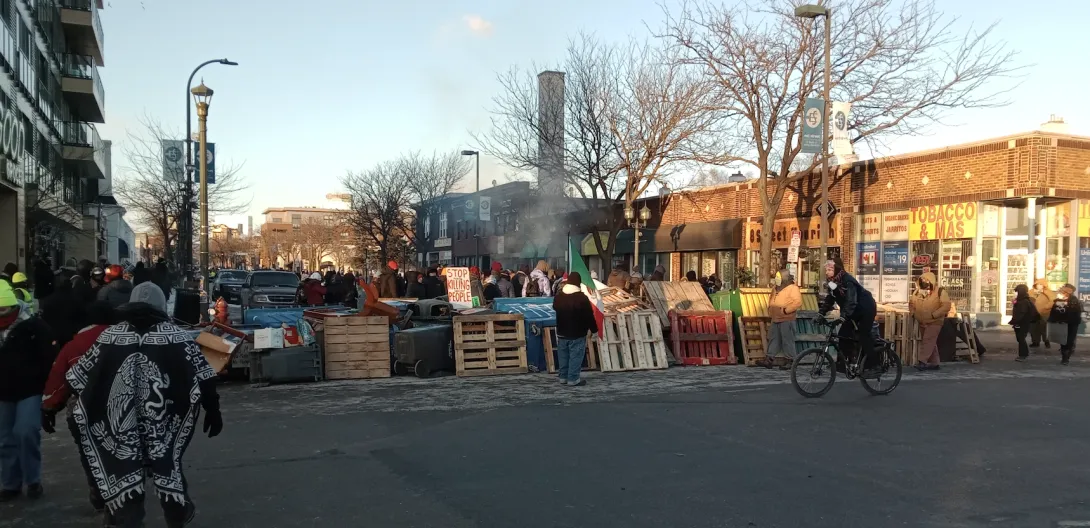
Shortly after noon, the exhausted and depleted police line began to crack. As they fell back, the remaining police piled onto any armored transport and squad car they could find, unleashing every irritant they had left into the advancing masses. People kicked and threw the munitions back into the police lines, and kept coming. This was the hour of the barricades, as trash bins, dumpters, and restaurant grease traps were pushed into the street, first as ad-hoc mobile shields for individual or small groups of protestors, and then coming together into a wall, claiming the space of Eat Street. Street medics rushed around, flushing out eyes and treating impact injuries, including at least one person with major damage to their hand from police munitions.
As the smoke cleared on the wind, the police and feds were gone- fleeing the neighborhood. They had been run for blocks. What had been a chase slowed into the victorious, steady pace of a march. The masses began a victory lap of Whittier, chanting in their grief, rage, and elation.
“Whose streets? Our streets!”
“Say his name! Alex Pretti!”
“Fuck ICE! ICE Out!”
“One hope! One dream! The fall of the regime!”
“10! 10! 10 toes down! Run the feds out of town!”
“Chinga la Migra!”
On the barricades, someone produced a loudspeaker, and folks from the crowd came forward, making speeches and calls to action. They mourned Alex. They cursed the occupiers. They celebrated their victory in the streets. Some called for the general strike to extend to Monday. With the hard fighting done, activists for local parties began hawking newspapers and pamphlets.
A few blocks from the speeches, the place where Alex had been murdered was already becoming a memorial shrine. Over the course of the day, it would be covered in flowers, prayer candles, posters, and other mementos to honor our neighbor, who in his resistance and death became our comrade.
The rising in Whittier rattled the ruling class both local and federal, of both parties. In the hours and days that follows, the Trump regime would ferry the agents out of the state and hide their identity. They doubled down on slandering Alex, accusing him of wanting to “massacre law enforcement officers” and “inflict maximum damage”. As the scale of their defeat in the streets and the weakness this exposed in their occupation became clear, they would start soft-walking these statements back. They put the officers who murdered Alex on leave, withdrew Bovino from the state and sent in border “Czar” Homan, and indicated that some investigation into the murder would take place. Every beholden to the whims of King Don, though, they continue to whip back and forth between conciliation and defensiveness, most recently releasing video they claim shows Alex confronting ICE agents 11 days prior to his murder. The video, meant to discredit Alex and paint him as a dangerous man, only swells the respect most working class Minneapolitans feel for our fallen brother.
Walz, meanwhile, finally gave in to his most reliable instinct, and mobilized the Minnesota National Guard. The Guard had previously been called in during the Uprising in 2020, providing security for the Minneapolis Police Department whose officers embarked on a campaign of reprisal asserting control over rebellious working class and black and brown neighborhoods. Later that summer, they would be called in immediately during the “False Rumors Riot”, and again the next year as a pre-emptive occupation during the trial of George Floyd’s murderer, Derek Chauvin. Throughout the occupation, the National Guard has been on standby, appearing briefly in town but not actually sent into the streets during the confrontations in Minneapolis on January 17 when so-called “Crusaders” were run out of Downtown. For more on that day, read our piece “Fascists Routed In Minneapolis!”. The Guard set up checkpoints around the Whittier autonomous zone, checking if people coming in were residents and forbidding materials that could sustain the rebellion. Cut off from the rest of the city and holding the barricades in brutal double digit below zero temperatures, the partisans in Whittier slipped away throughout the night, and the MPD dismantled the barricades in the morning.
Perhaps it is better that our city’s defenders did not pour too much energy into taking and holding one occupation in one space. Often, that tactic can draw resources and the attention of committed activists and organizers away from the rest of a city, and make a more easily contained bubble for the forces of counter-insurgency to police, surveill, and contain. Our struggle is across the whole metro, the whole state, the whole country and world. Our strength comes from our bonds to others in our neighborhoods, workplaces, and communities, and our work demands that we attend to daily rapid response and mutual aid needs across the Twin Cities and beyond.
The responses from Walz and Trump show that the ruling class, in its different factions, is struggling to keep control of the situation. We can expect our local DFL-led government to adapt and adjust. They will likely try to isolate and repress the more militant and revolutionary side of the movement to demonstrate to the federal government thay they can handle the spiraling crisis. But they will keep expressing public support for the movement while attempting co-opt and control that which they can. They may try to work with the Trump administration to carry out ICE enforcement in a more “professional”, focused, and less inflammatory way. The Trump administration, meanwhile, may double down, unwilling to be percieved as weak. On the other hand, it may try to find a way to claim victory while cutting its losses and avoiding further deescalation and embarrassment. Much depends on our mercurial aspiring monarch, and whoever is the most recent person in Trump’s inner circle to catch his ear. For an analysis of some of these changes, read our new piece: “Choices and Consequences: Tim Walz and the Art of the Deal”
The barricades rose in Whittier last weekend. It was not the first time for our city, and a betting man would lay good odds that it will not be the last. Faced with the power of the general strike, of civil disobedience, and mass direct action, the regime tried to tighten its grip. Its aggressive, ideologically fanatic, and poorly disciplined hitmen killed another one of our neighbors, and made a martyr. In killing the man, they gave birth to a rebellion. This is the cycle of tyranny and resistance- one that tyrants never seem to learn. With each murder, each martyr they make, the regime sets fire to its own foundations and its own future. Here in Minneapolis, we are making a new world in our hearts, ready to rise from the ashes of the old.
Comments